
The electromagnetic vs ultrasonic question usually gets answered by conductivity, and it usually gets answered wrong because the person asking has already decided. Both meters have an empty bore, both have no moving parts, and both claim half a percent on a good day. The differences are in what they need from the installation.
Here is the short version. If the liquid conducts and the pipe can be opened, an electromagnetic flowmeter is more accurate and cheaper to own. If the pipe cannot be opened, or the liquid does not conduct, an ultrasonic meter is the only option. Everything else is detail.
On this page
The question that decides it
An electromagnetic flowmeter needs the liquid to conduct electricity. Below about 5 microsiemens per centimetre there is no usable signal and electromagnetic vs ultrasonic reads zero. An ultrasonic meter needs the liquid to carry sound, which almost everything does.
So the first question is not accuracy or price. It is whether the liquid conducts. Water, wastewater, acids, alkalis, seawater and most aqueous solutions conduct. Diesel, kerosene, most solvents, deionised water and liquid gas do not.
If the liquid does not conduct, the electromagnetic vs ultrasonic decision is over and the answer is ultrasonic, or a turbine if the liquid is clean. If it does conduct, the decision moves on to installation and cost.
How each meter works
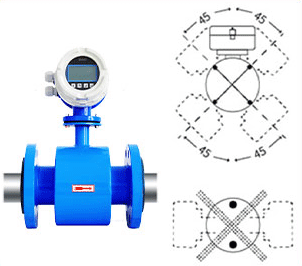
An electromagnetic flowmeter applies Faraday’s law. Coils generate a magnetic field across the pipe, the conducting liquid moving through it generates a voltage, and two electrodes in the liner measure that voltage. The signal is proportional to velocity and it is measured across the full bore.
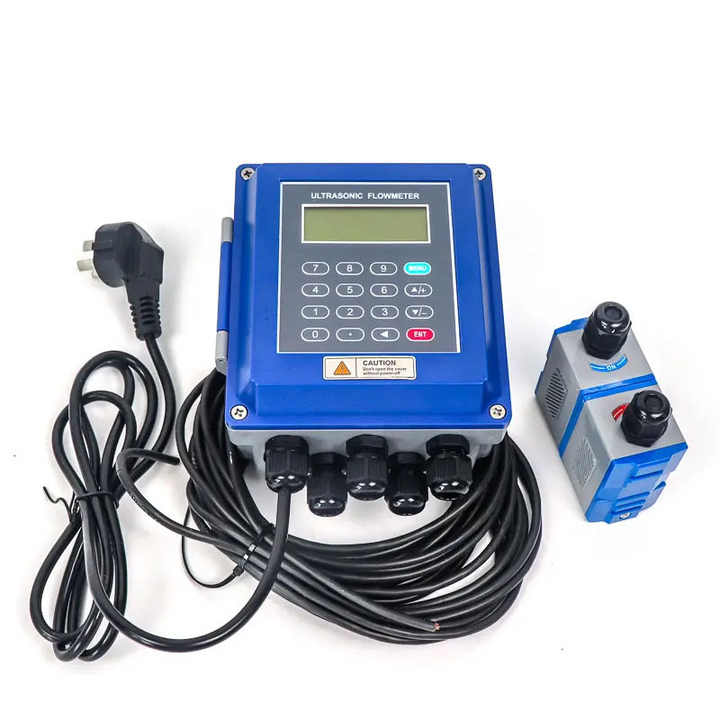
An ultrasonic meter measures transit time. Two transducers outside the pipe send pulses through the wall and the liquid, one with the flow and one against it. The difference in arrival time gives the average velocity along the sound path.
The distinction that matters is where the measurement happens. The electromagnetic flowmeter integrates across the whole cross section because the field fills the bore. The ultrasonic meter measures along one or more chords, and it depends on knowing the profile to convert chord velocity into average velocity.
Accuracy compared
An electromagnetic flowmeter holds half a percent of reading on a well installed full bore unit, and it holds it across a hundred to one turndown. There is no profile assumption because the measurement is volumetric across the bore.
An ultrasonic meter holds one percent of reading on a clamp on installation and half a percent on a calibrated multi-path inline unit. The gap is not the electronics, it is the pipe data and the profile.
The practical difference shows up when the pipe data is uncertain. An electromagnetic flowmeter needs the bore diameter, which is known. An ultrasonic meter needs the outside diameter, the wall thickness and the material, and a two millimetre error in wall thickness moves the reading by more than one percent.
Turndown
Both are excellent. An electromagnetic flowmeter reaches 1:100 without effort because the relationship between voltage and velocity is linear. An ultrasonic meter reaches similar turndown, limited by the signal to noise ratio at low velocity.
Installation and shutdown cost
This is where the electromagnetic vs ultrasonic comparison usually gets decided in practice. An electromagnetic flowmeter is a spool piece. Installing it means cutting the pipe, welding flanges and shutting the line down.
An ultrasonic meter clamps on the outside. No cutting, no shutdown, and the installation can be done while the plant runs.
On a new build, the shutdown cost is zero because the pipe is being built anyway. On a retrofit, the shutdown can easily exceed the price of electromagnetic vs ultrasonic, and that single number decides the technology more often than any specification.
The counter argument is the accuracy of the installation. A clamp on ultrasonic flow meter installed badly reads two to three percent wrong for years, and nobody notices because it reads plausibly. An electromagnetic flowmeter either works or reads zero, which is easier to diagnose.
Pipe size economics
| Pipe size | Electromagnetic | Ultrasonic clamp on |
|---|---|---|
| DN25 | Low cost, accurate | Poor value, below reliable range |
| DN50 | Low to moderate | Comparable, less accurate |
| DN100 | Moderate | Comparable |
| DN300 | High | Lower |
| DN600 | Very high, fabrication project | Clearly cheaper |
| DN1200 | Impractical in most budgets | Standard solution |
The crossover is around DN100 to DN150. Below it the electromagnetic flowmeter is usually cheaper and always more accurate. Above it the ultrasonic meter wins on cost and installation, and the accuracy gap narrows if you specify a two path unit.
Fluids each one handles
The electromagnetic flowmeter handles water, wastewater, slurry, pulp, acids, alkalis, brine and food products. It does not handle hydrocarbons, solvents, deionised water or gas.
The ultrasonic meter handles water, seawater, oil, chemicals, liquefied gas at high pressure and most homogeneous liquids. It struggles with anything that scatters sound, which means bubbles and high solids.
Notice the overlap. On water both work, and the decision is installation and cost. On oil only ultrasonic works. On slurry only electromagnetic works reliably.

Slurry and dirty liquid
An electromagnetic flowmeter is the better instrument for slurry, and it is not close. The empty bore passes solids without obstruction, the liner can be ceramic or hard rubber for abrasion, and the measurement does not depend on the sound path staying clear.
An ultrasonic meter on slurry runs into two problems. The solids attenuate the signal, and above about 10,000 ppm the transit time method stops working. The Doppler variant handles higher solids but at much lower accuracy.
If the liquid carries fibres, the electromagnetic flowmeter also wins, because fibres wrap around an ultrasonic transducer face and around a turbine rotor but pass straight through an empty bore.
Cost of ownership
An electromagnetic flowmeter has no wear parts, but the liner and electrodes do age. A rubber liner on abrasive slurry lasts two to three years. A PTFE liner on chemical service lasts ten.
An ultrasonic meter has no wear parts in contact with the liquid at all, because the transducers are outside. The coupling compound dries out and needs refreshing, and the transducers themselves last a decade.
The hidden cost on both is the installation. An electromagnetic flowmeter installed with poor grounding reads noise for its whole life. An ultrasonic meter installed without measured pipe data reads a consistent error for its whole life. Neither is repairable by the supplier.
Decision table
| Condition | Choose |
|---|---|
| Liquid conducts, pipe can be opened | Electromagnetic |
| Liquid does not conduct | Ultrasonic, or turbine if clean |
| Pipe cannot be shut down | Ultrasonic clamp on |
| Pipe above DN600 | Ultrasonic, or insertion electromagnetic |
| Slurry or fibres | Electromagnetic |
| Custody transfer on water | Electromagnetic full bore |
| Temporary survey | Ultrasonic portable |
| Pipe below DN32 | Electromagnetic or turbine |
Read the table as a first pass. The second pass is the shutdown cost, and on a live plant that number usually settles the electromagnetic vs ultrasonic argument before the specifications are compared.
Three real cases
A water utility replacing a DN400 distribution meter. The pipe can be shut down overnight at low demand, the water conducts, and custody transfer accuracy is required. Electromagnetic flowmeter, full bore, with a grounding ring on both flanges. The ultrasonic option was cheaper to install and could not hold the accuracy the billing rule required.
A data centre cooling loop that cannot be interrupted. The pipe is DN300 steel, the fluid is treated water, and there is no shutdown window in the foreseeable future. A two path clamp on ultrasonic flow meter with measured wall thickness. The electromagnetic flowmeter would have been more accurate and could not be installed.
A chemical plant metering a solvent. Conductivity is effectively zero, so the electromagnetic flowmeter is out immediately. The ultrasonic meter works, and the alternative was a Coriolis meter at four times the price.
Three cases, three different answers, and in each one a single constraint decided it. That is how the electromagnetic vs ultrasonic choice usually goes in practice, and it is why the comparison tables matter less than the constraint list.
Installation difficulty compared
The electromagnetic vs ultrasonic comparison often comes down to which one a site can actually install correctly, and the two have very different failure modes during installation.
An electromagnetic flowmeter is mechanically demanding. The spool has to be cut in, the flanges have to align, the liner has to be protected during welding, and the earth has to be bonded on both sides. Get any of those wrong and electromagnetic vs ultrasonic reads noise. The advantage is that the errors are obvious immediately: a badly earthed meter reads a wandering zero before it ever sees flow.
An ultrasonic meter is mechanically simple and analytically demanding. Nothing is cut and nothing is welded, but the pipe outside diameter, the wall thickness and the material all have to be measured and entered correctly, and the transducer spacing has to be set to a millimetre. Get any of those wrong and electromagnetic vs ultrasonic reads a stable, plausible, wrong number for years.
That asymmetry is worth thinking about. electromagnetic vs ultrasonic that fails loudly is easier to live with than one that fails quietly, and it is one argument for the electromagnetic flowmeter on a site where the installation will be done by a contractor under time pressure.
Maintenance compared
Neither meter has moving parts, so the maintenance comparison is about access rather than wear.
An electromagnetic flowmeter needs the line isolated for an electrode inspection, which means a shutdown. Electrode cleaning is a ten minute job once electromagnetic vs ultrasonic is out and a two day job once the isolation, the permit and the reinstatement are counted.
An ultrasonic meter can be re-greased without touching the process. The transducers lift off, the coupling compound is refreshed, and electromagnetic vs ultrasonic goes back on the same marks. That is a fifteen minute job with the plant running.
Over a ten year life, that difference is significant on a line that coats. On a clean water line neither meter needs anything beyond a calibration check, and the comparison becomes irrelevant.
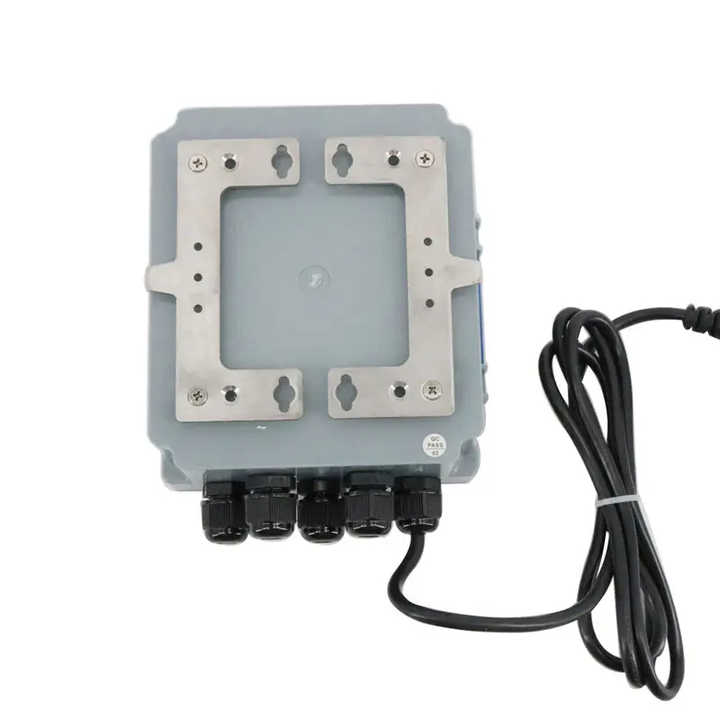
The other maintenance item is the electronics. Both have a converter that can fail, and both can be swapped without breaking the pressure boundary if the design allows a remote mount. Specify remote mounting if the converter is in a hot or wet location, because a converter in a puddle fails more often than a converter in a cabinet.
Choosing when both will work
On a clean water line with a shutdown window, both meters work and the decision is commercial. This is where the electromagnetic vs ultrasonic comparison becomes a straight cost exercise.
Compare the installed cost, not the purchase price. The electromagnetic flowmeter needs flanges welded, a spool fabricated, a shutdown and a commissioning visit. The ultrasonic meter needs a pipe measurement, two hours of mounting and a configuration.
On a new build the welding is happening anyway, so the electromagnetic flowmeter’s installation cost collapses and it wins on accuracy per pound. On a retrofit the shutdown dominates and the ultrasonic meter wins almost every time.
Then add the ownership cost. Neither has wear parts in the flow, and both need a calibration check every few years. The ultrasonic meter needs coupling compound refreshed, which is a fifteen minute job. The electromagnetic flowmeter needs the line isolated for an electrode inspection, which is a shutdown.
That last difference is the one people forget. electromagnetic vs ultrasonic that can be maintained while running is worth more than half a percent of accuracy on a line that cannot be stopped.
Four mistakes in this comparison
Buying the ultrasonic meter because it avoids a shutdown, then installing it without measuring the pipe. electromagnetic vs ultrasonic reads a stable two percent error for a decade and the shutdown saving is spent on wrong data.
Buying the electromagnetic flowmeter for a liquid that barely conducts. Below 5 microsiemens per centimetre it reads nothing, and the conductivity was never checked because the liquid looked like water.
Comparing purchase prices instead of installed costs. On a DN300 retrofit the installation difference is larger than the price difference by a factor of three.
Assuming a clamp on unit can be used for billing. Most metrology rules require a certified meter, and a clamp on ultrasonic meter usually does not qualify even when it is more accurate than the certified alternative.
The short answer
If the liquid conducts and the pipe can be opened, buy the electromagnetic flowmeter. It is more accurate, it handles dirt, and it has no wear parts in the flow.
If the pipe cannot be opened, or the liquid does not conduct, buy the ultrasonic meter. It is the only option in the first case and the better option in the second.
If both work and both can be installed, compare the installed cost rather than the purchase price, and remember that the shutdown is usually the largest line item on a retrofit.
That is the whole electromagnetic vs ultrasonic decision. Everything else in this article explains why those three sentences hold.
The questions that settle the electromagnetic vs ultrasonic choice
Every electromagnetic vs ultrasonic discussion in a project meeting follows the same route if it is done properly. Ask the questions in order and the answer appears without anyone having to argue about specifications.
Does the liquid conduct? That single question settles most electromagnetic vs ultrasonic comparisons before they start, because a non-conductive liquid removes one of the two options entirely.
Can the pipe be opened? The second question settles the retrofit case, where the electromagnetic vs ultrasonic decision is really a decision about shutdown cost rather than measurement technology.
How big is the pipe? Above DN300 the electromagnetic vs ultrasonic comparison starts to favour the clamp on unit on cost, and above DN600 it usually decides the matter outright.
Does the liquid carry solids? Slurry settles the electromagnetic vs ultrasonic argument in favour of the electromagnetic flowmeter, because an ultrasonic signal does not survive high solids loading.
Is the number used for billing? Custody transfer settles the electromagnetic vs ultrasonic question in favour of a full bore certified meter, and a clamp on unit rarely qualifies regardless of its accuracy.
Five questions, and every electromagnetic vs ultrasonic decision in this article comes out of them. Write the answers down before the meeting and the meeting takes ten minutes.
Common questions
In the electromagnetic vs ultrasonic comparison, which is more accurate?
Electromagnetic, at half a percent of reading against one percent for a clamp on ultrasonic. The gap closes to near zero if the ultrasonic unit is inline, multi-path and calibrated, but then the cost advantage disappears.
Can an ultrasonic meter measure non-conductive liquids?
Yes. That is its main advantage over the electromagnetic flowmeter. Diesel, solvents and liquefied gas all work on transit time ultrasonic.
Does an ultrasonic meter need the pipe emptied?
No. That is the other main advantage. The transducers mount on the outside and the line stays in service.
Which handles slurry better in an electromagnetic vs ultrasonic comparison?
The electromagnetic flowmeter, clearly. An empty bore passes solids and the measurement does not depend on a clear sound path.
At what pipe size does the electromagnetic vs ultrasonic crossover happen?
Around DN100 to DN150 for new build, and around DN50 for retrofit where the shutdown cost is counted. Above DN600 the clamp on ultrasonic is usually the only affordable option.
Can I use an ultrasonic meter for billing?
Only with a multi-path inline unit and local approval. Many jurisdictions require a certified meter for custody transfer, and a clamp on unit usually does not qualify even when it is accurate.
Related reading
For the full specification of each, see the electromagnetic flow meter and the clamp on ultrasonic flow meter. If neither fits because the liquid is clean and non-conductive, a liquid turbine flow meter is the economical answer. For the wider decision, start with the flow meter selection guide.
Reference for both technologies: ISO 12242 covers ultrasonic transit time meters and ISO 20456 covers electromagnetic flowmeters, including the installation conditions behind every accuracy claim.