

An electromagnetic flowmeter has an empty bore and no moving parts. Coils around the pipe generate a magnetic field, the conductive liquid moving through it generates a voltage, and electrodes in the wall measure that voltage. Nothing obstructs the flow, nothing wears, and the pressure loss is the same as a length of straight pipe.
That combination is why the electromagnetic flowmeter dominates water, wastewater and most chemical service. It handles dirty liquids that would destroy a turbine, it measures slurry without complaint, and it does not care about viscosity, density or temperature as long as the liner and the electrodes can take them.
On this page
- How the electromagnetic flowmeter works
- Liner selection
- Electrode selection
- Specifications
- The conductivity requirement
- Grounding: the usual failure
- Installation
- What moves the accuracy
- Compared with ultrasonic and vortex
- Applications by industry
- Troubleshooting a reading
- Ordering checklist
- Common questions
How the electromagnetic flowmeter works
Faraday’s law of induction says that a conductor moving through a magnetic field generates a voltage perpendicular to both. In an electromagnetic flowmeter the conductor is the liquid, the field comes from coils wrapped around the pipe, and the voltage appears across two electrodes set into the liner at right angles to the field.
The voltage is tiny. At a flow of one metre per second in a DN100 pipe, the signal is a few millivolts, and the electronics have to resolve it against noise from the coils, the pump and the plant earth. That is why grounding matters more on electromagnetic flowmeter than on any other.
The relationship is linear and it depends only on the field strength and the pipe geometry. Velocity is proportional to voltage, so the electromagnetic flowmeter is linear across its whole range and its turndown is limited by the electronics rather than the physics.
Why the bore is empty
Nothing sits in the flow path. No bluff body, no rotor, no orifice. The only intrusion is the two electrodes, which are flush with the liner. That is why the pressure loss is negligible and why electromagnetic flowmeter handles fibrous and abrasive slurries that would block or erode anything else.

Liner selection
The liner is the material between the liquid and the pipe wall, and it is the single most important specification decision on an electromagnetic flowmeter. Get it wrong and the meter fails in months, not years.
| Liner | Temperature | Abrasion | Chemicals | Typical service |
|---|---|---|---|---|
| Hard rubber | -10 to 80 C | Excellent | Limited | Water, wastewater, slurry |
| Soft rubber | -10 to 60 C | Good | Limited | Water with mild abrasion |
| PTFE | -30 to 180 C | Moderate | Excellent | Acids, alkalis, solvents |
| PFA | -30 to 180 C | Moderate | Excellent | Hot chemicals, food |
| F46 | -20 to 150 C | Good | Very good | General chemical |
| Ceramic | -20 to 180 C | Excellent | Good | Severe abrasive slurry |
Hard rubber is the default for water and wastewater. It is cheap, it handles abrasion better than any fluoropolymer, and it tolerates the mild chemicals found in municipal service. Do not put PTFE on an abrasive slurry, because the PTFE will wear through and the meter will read earth instead of flow.
PTFE and PFA are for chemical service where the liquid would attack rubber. They handle a wide pH range and most solvents, but they are soft and they do not like abrasion or a high velocity slurry. PFA is the better choice for hot chemical service and for food, because it has fewer seams and a smoother surface.
Ceramic is for the hard cases, such as alumina slurry or fly ash. It is expensive and it is brittle, so it needs careful handling during installation, but nothing else survives that duty.

Electrode selection
The electrodes are in contact with the liquid, so they have to survive it. Four materials cover almost everything.
SS316L is the default for water, wastewater and mild chemicals. It is cheap and it works until it does not, which is usually in a chloride environment or an acid.
Hastelloy C is the general purpose upgrade for seawater, chlorides and oxidising acids. If you are unsure and the liquid is aggressive, Hastelloy is the safe choice and it costs a fraction of the meter.
Titanium suits seawater and hypochlorite, where Hastelloy would also work but costs more. Tantalum is for hot concentrated acids, and it is the most expensive option, so specify it only when the chemistry demands it.
Platinum is used for food and pharmaceutical service where contamination matters and the liquid is not aggressive enough to need tantalum.
Specifications
| Parameter | Range |
|---|---|
| Nominal diameter | DN15 to DN3000 |
| Accuracy | plus or minus 0.5 percent of reading, plus or minus 1.0 percent optional |
| Repeatability | 0.1 percent of reading |
| Turndown | 1:100 typical |
| Velocity range | 0.3 to 12 m/s recommended |
| Conductivity | above 5 uS/cm, above 20 uS/cm for best accuracy |
| Nominal pressure | 1.6 MPa standard, 2.5 / 4.0 MPa optional |
| Medium temperature | -30 C to +180 C, liner dependent |
| Liner | Rubber, PTFE, PFA, F46, ceramic |
| Electrode | SS316L, Hastelloy C, titanium, tantalum, platinum |
| Body | Carbon steel with epoxy coating, or stainless steel |
| Straight run | 5 DN upstream, 3 DN downstream |
| Output | 4-20 mA, pulse, RS485 Modbus, HART optional |
| Protection | IP65 standard, IP68 for submersible |
| Power supply | 220 VAC, 24 VDC, or battery |
The 0.5 percent figure assumes a full pipe, a developed profile and a grounded installation. Take away any of those and the electromagnetic flowmeter reads 2 percent or worse, and the certificate will not help you.
The conductivity requirement
The liquid has to conduct electricity. Below about 5 microsiemens per centimetre the signal becomes too weak to resolve and the electromagnetic flowmeter reads zero or drifts. That rules out deionised water, most hydrocarbons, and a lot of solvents.
Water from a municipal main is typically 200 to 800 uS/cm, comfortably inside the range. Seawater is around 50,000 uS/cm, which is why the meter is so at home on ships and coastal plants. Diesel and kerosene are effectively zero, which is why fuel metering uses turbines instead.
If the liquid is borderline, ask for a sample test before you buy. electromagnetic flowmeter specified on an assumption about conductivity is a meter that might read nothing on commissioning day, and that is an expensive way to learn the number.
Grounding: the usual failure
An electromagnetic flowmeter measures millivolts. Any stray current in the pipe finds its way through the electrodes and swamps the signal. That is why the grounding rings or the grounding electrodes matter, and why a floating installation reads nonsense.
Ground electromagnetic flowmeter to the pipe on both sides, and bond the pipe to the plant earth. On a plastic or lined pipe, use grounding rings on both flanges so the liquid has a reference. On a cathodically protected pipe, use a special grounding arrangement rather than a direct bond, or you will drain the protection current.
The symptom of a grounding fault is a reading that jumps when a nearby pump starts, or a zero that will not settle. Both look like an electronics failure and both are cured by fixing the earth.
Installation
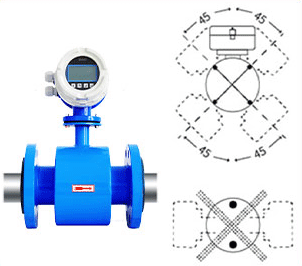
- Five diameters upstream, three downstream. Count from the flange face.
- Keep the pipe full. Mount in a rising section or in a low point with a downstream rise.
- Do not mount at the highest point of a line, where air collects.
- Electrodes should be horizontal, not at the top or bottom, so air and sediment do not sit on them.
- Ground the body on both sides. Use grounding rings on non-conductive pipe.
- Leave room to remove the meter. It is a heavy item and it will need to come out eventually.
- On a vertical line, upward flow is preferred so the pipe stays full.
- Do not install downstream of a partly closed valve or a pump discharge without straight run.
What moves the accuracy
A partially full pipe is the biggest error source. The electromagnetic flowmeter assumes the cross section is completely liquid. If the pipe is running half full, the meter reads high because it computes velocity from the full area.
An uneven profile is the second. Two elbows in different planes upstream create a swirl that persists, and a single pair of electrodes samples one chord of it. Five diameters and a straight run fixes it.
Coated electrodes are the third, and the slowest to notice. Grease, scale or a chemical film insulates the electrode and the signal fades. The reading drifts low over months and nobody sees it until a comparison audit.
And a worn liner is the fourth. An abrasive slurry eventually wears through the liner, and once the liquid reaches the body the meter reads earth. That is a sudden failure after a long period of slow wear, which is why liner thickness is worth checking on a planned outage.

Insertion versions and large pipe
Above DN600 the full bore electromagnetic flowmeter becomes a pressure vessel with a price to match. An insertion electromagnetic flowmeter puts one or two small sensors through the pipe wall instead, at a fraction of the cost, and installs through a tapping valve without shutting the line.
The trade is accuracy. An insertion unit samples velocity at one point or along one chord, so it depends on a known profile. On a long straight run of a large water main that is fine, and one percent is achievable. On a short run with a distorted profile it is not, and the error can reach five percent.
Full bore remains the right choice for custody transfer, for slurry, and for any line where the profile cannot be trusted. Insertion is right for large water mains, for cooling water, and for retrofits where a shutdown is not available.
Sizing by velocity
Size the electromagnetic flowmeter so the normal flow sits at 2 to 4 m/s. That is the band where the meter is most accurate, the electrodes stay clean, and the pressure loss is still negligible.
Below 0.3 m/s the signal gets small and the reading becomes noisy. Above 6 m/s the liner starts to see erosion on abrasive service, and above 10 m/s the noise from the flow itself begins to affect the measurement.
The most common sizing error is choosing the meter to match the pipe. A DN200 line carrying 30 m3/h of water has a velocity of 0.27 m/s, which is below the useful range. A DN100 electromagnetic flowmeter with reducers would run at 1.1 m/s and read properly, and the reducers cost less than the accuracy you lose by staying full bore.
Sanitary and food grade versions
Food, beverage and pharmaceutical service needs three changes from the industrial electromagnetic flowmeter: a smooth crevice free liner, a sanitary connection, and materials that survive clean-in-place.
PFA is the usual liner because it can be moulded without seams and it takes a polished finish. Platinum electrodes are used where the product is aggressive enough to attack stainless but not aggressive enough to need tantalum. The connection is a clamp or a DIN union rather than a flange, so the meter can be dismantled for inspection.
The clean-in-place cycle sets the temperature limit, not the product. A liner rated to 150 C for product may only take 120 C for a repeated caustic wash, and the difference matters over a five year life. Check the wash cycle against the liner data sheet before ordering.
Hygienic installations also need the meter mounted so it drains completely. A horizontal electromagnetic flowmeter with a slight fall to the outlet drains; one installed dead level holds a puddle, and a puddle is where the next batch gets contaminated.
Compared with ultrasonic and vortex
| Electromagnetic | Clamp on ultrasonic | Vortex | |
|---|---|---|---|
| Moving parts | None | None | None |
| Conductivity needed | Yes | No | No |
| Pipe cutting | Yes | No | Yes |
| Accuracy | 0.5 percent | 1.0 percent | 1.0 to 1.5 percent |
| Slurry | Excellent | Moderate | Poor |
| Gas and steam | Not possible | Limited | Excellent |
| Cost at DN200 | Moderate | Moderate | High |
Against a clamp on ultrasonic flow meter, the electromagnetic flowmeter is more accurate and handles slurry better, but it needs the pipe opened and the liquid to conduct. Against a vortex flow meter, it wins on slurry and pressure loss and loses on gas and steam, which it cannot measure at all.
Applications by industry
Water and wastewater is the largest application. Raw water, treated water, return sludge, digester feed and chemical dosing all use the electromagnetic flowmeter, and hard rubber liners with SS316L electrodes cover most of it.
Chemical plants use PTFE or PFA liners with Hastelloy or tantalum electrodes, depending on the acid. The meter handles the whole pH range and it does not care about the density or the viscosity.
Food and beverage uses sanitary connections, PFA liners and platinum electrodes. Clean-in-place cycles set the temperature limit, so check the liner rating against the wash cycle rather than the product temperature.
Mining and mineral processing use ceramic liners for the abrasive slurry, and the meter’s empty bore is the reason it survives where a turbine would be destroyed in weeks.
Troubleshooting a reading
A reading of zero with flow present is usually an empty pipe detection or a grounding fault. Check the earth first, then the electrode connections, then the empty pipe setting.
A reading that jumps with pump starts is a grounding or shielding problem. Check the cable screen, the earth bond and the separation from power cables.
A reading that drifts low over months is electrode coating. Pull the meter, clean the electrodes, and consider a different electrode material if the coating recurs.
A reading that is consistently high is a partially full pipe or a wrong pipe size in the configuration. Check the installation angle and the programmed diameter before you suspect the electronics.
Ordering checklist
- Liquid, concentration, temperature and conductivity
- Maximum, normal and minimum flow
- Line size, flange standard and pressure class
- Liner material, driven by chemistry and abrasion
- Electrode material, driven by chemistry
- Grounding arrangement, and whether rings are needed
- Output, protocol and power supply
- Whether the area is hazardous, and the classification
Common questions
Can an electromagnetic flowmeter measure diesel?
No. Diesel conductivity is far below the 5 uS/cm threshold. A liquid turbine flow meter is the right instrument for fuel.
What conductivity does an electromagnetic flowmeter need?
Above 5 uS/cm to read at all, and above 20 uS/cm for the published accuracy. Municipal water, seawater and most chemical solutions are comfortably inside that range.
Why is my electromagnetic flowmeter reading high?
Usually a partly full pipe. The meter computes velocity over the full cross section, so if the liquid only fills half the pipe the reading is roughly double. Check the installation angle and whether air is trapped.
Does an electromagnetic flowmeter need straight run?
Five diameters upstream and three downstream. That is much shorter than a vortex meter and similar to a turbine.
Can it be installed underground?
Yes, with an IP68 rating and a remote converter. The meter body can be buried while the electronics stay accessible in a cabinet.
How long does the liner last?
Ten years or more on clean liquid, two to three years on severe abrasive slurry. Check the liner thickness on a planned outage if the duty is abrasive.
Related reading
If the pipe cannot be opened, read about the clamp on ultrasonic flow meter. If the liquid is non-conductive, a liquid turbine flow meter is the alternative. And for the wider technology comparison, see electromagnetic versus ultrasonic.
Reference for electromagnetic flowmeter standards: ISO 20456 covers the calibration and installation requirements for industrial electromagnetic flowmeters.