
The microbiology lab found it first. A spoilage organism turning up in finished product, intermittently, on one line only. Three months of swabbing, two rounds of retraining, and eventually a borescope into the meter body on the transfer line. There was a ring of product residue sitting in the crevice between the liner and the flange — a place no CIP cycle could reach, and a place a standard industrial meter had no business being.
The meter had been measuring milk perfectly for eighteen months. That was never the problem.
What “sanitary” actually changes
Three design differences, and only one of them is about the wetted material.
Geometry. No crevices, no dead legs, no threaded connections. The flow path must be smooth and self-draining, and every internal radius cleanable. That is what 3-A and EHEDG certification actually test.
Connection. Clamp (Tri-Clamp), DIN 11851, SMS or RJT. The joint must come apart for inspection and go back together without a gasket that traps product.
Surface and material. 316L wetted parts, Ra ≤ 0.8 µm on the flow path, and a liner that survives 80°C caustic and 1.5% nitric acid on alternating days.
| Duty | Typical build | Why |
|---|---|---|
| Milk, beer, juice, syrup | 316L body, PFA or PTFE liner, clamp ends | CIP acid and caustic resistance, smooth bore |
| CIP supply and return | 316L, PFA liner, clamp ends | Repeated 80°C caustic exposure |
| High-fat dairy | 316L, PFA liner, heated jacket option | Fat solidifies below 35°C and coats electrodes |
| Brewing wort and green beer | 316L, PFA, clamp ends, low-flow cut-off | Entrained CO₂ and yeast disturb the signal |
| Concentrate, viscous product | Coriolis mass meter | Direct mass measurement plus density |
The CIP cycle drives the specification
A brewery might run four cleaning cycles a day: 1.5% caustic at 80°C for twenty minutes, intermediate rinse, 1% nitric or phosphoric at 60°C, final rinse. That is roughly 1,400 caustic exposures a year plus thermal cycling. A liner that swells 0.2 mm a year becomes a problem long before it fails outright.
PTFE and PFA both handle this. EPDM is acceptable for some duties but swells in contact with certain oils and hop compounds. Natural rubber is wrong for food duty despite being common on water meters.
Electrodes matter as much. Hastelloy C handles both the caustic and the acid. Titanium is fine for caustic but not the acid step. Tantalum is the safe answer for aggressive combined duty, costs more, and should not be used with strong alkalis above pH 10.
Cleaning depends on velocity, not volume
CIP effectiveness is a function of wall shear, which means velocity. The working target is 1.5 m/s — about 5 ft/s — sustained for the contact time. So the flow meter has to be accurate at a specific velocity, not merely over a range, and it has to hold that accuracy when the cleaning solution is at 80°C and the pump is running on a different curve than it does on product.
Two practical notes. Set the CIP setpoint from the meter reading, not from the pump curve. And log velocity per cycle: if it drops 15% because a valve is partly blocked, cleaning performance drops with it and nothing else in the plant will tell you.
Where the meters go
Product inlet and outlet of each process block. Electromagnetic, clamp ends, sized so normal flow sits between 1 and 3 m/s. Below 0.5 m/s the signal gets noisy; above 4 m/s erosion starts in abrasive products.
CIP supply line. One meter per CIP skid, sized for the highest cleaning velocity required by the largest circuit. Often a smaller line than the product line, and it deserves its own meter.
Water and utilities. A standard industrial meter is fine. Nobody audits the hygienic design of a cooling water line.
Filling and dosing. Electromagnetic or Coriolis depending on batch accuracy. For filling, response time matters more than steady-state accuracy.
Installation mistakes that create hygiene problems
Meter installed as a low point. Product pools in the body after draining. Mount in a rising line, or provide a drain.
Wrong gasket at the clamp joint. A standard EPDM gasket in a clamp fitting is not a 3-A gasket. It traps product at the joint face.
Meter on the end of a dead leg. Any branch longer than two pipe diameters that is not regularly flushed is a microbial risk. Move the meter into the main run.
Empty-pipe operation. CIP circuits drain and refill. An electromagnetic meter reading an empty pipe outputs noise the control system interprets as flow. Enable empty-pipe detection and use it to inhibit totalising.
Brewing, spelled out
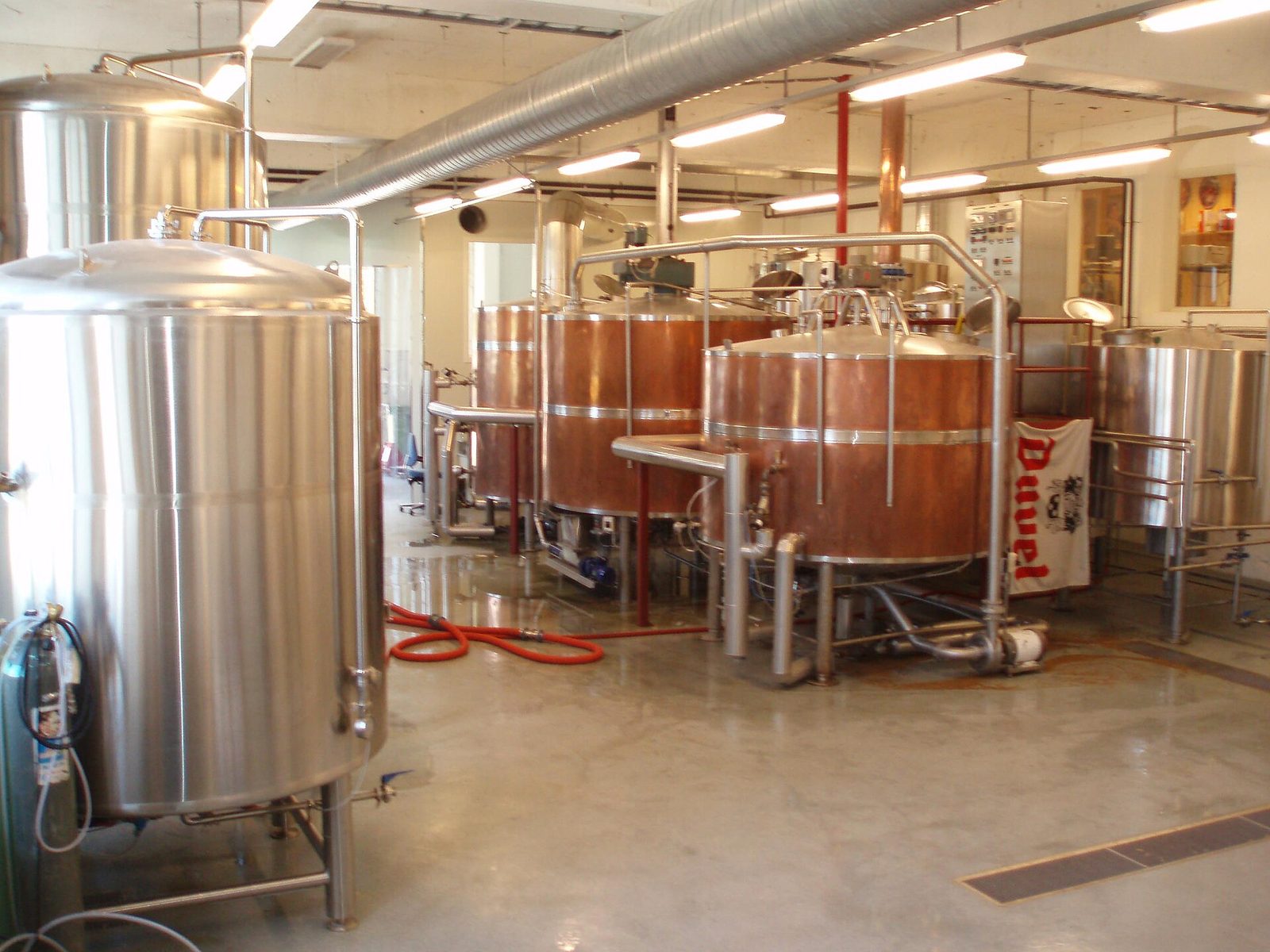
A 50 hl brewhouse — about 42 US barrels — typically meters: brewing water in, wort out of the mash tun, wort to the kettle, whirlpool transfer, wort to fermenter, and CIP supply. Six points, all clamp-connected, all 316L.
The one that causes trouble is wort to fermenter, because it carries trub and hop particles and the transfer is often stopped on a volume total rather than a level. A meter with a fast update rate and a reliable low-flow cut-off matters more here than an accuracy class. Specify 0.5%, but insist on a cut-off that engages cleanly at 0.1 m/s.
Green beer and bright beer lines add CO₂. Entrained gas breaks the electromagnetic signal. If the line is known to carry gas, Coriolis is the safer choice despite the cost.
Frequently asked questions
Is 3-A certification mandatory?
Not by law in most countries, but mandatory by customer audit in dairy and much of the beverage industry. If your customers ask for it, buy certified hardware rather than arguing equivalence.
Can I use a standard electromagnetic meter on a food line if I clean it manually?
On raw-material intake ahead of any thermal process, sometimes. Anywhere downstream of the kill step, no. The risk is not worth the saving.
Do I need a separate meter for CIP?
If the CIP circuit differs in line size or velocity requirement from the product line, yes. Sharing one meter usually means running CIP at the wrong velocity.
What accuracy is realistic?
±0.5% of reading is achievable and sufficient for most batching. For filling and product-loss accounting, ±0.2% with Coriolis is the practical ceiling.
The material logic in food service is a softer version of what chemical plants demand — liner and electrode selection for corrosive chemicals goes through the full pairing table. And where the plant also makes its own purified water, pharmaceutical water flow measurement covers the conductivity problem that comes with it.