
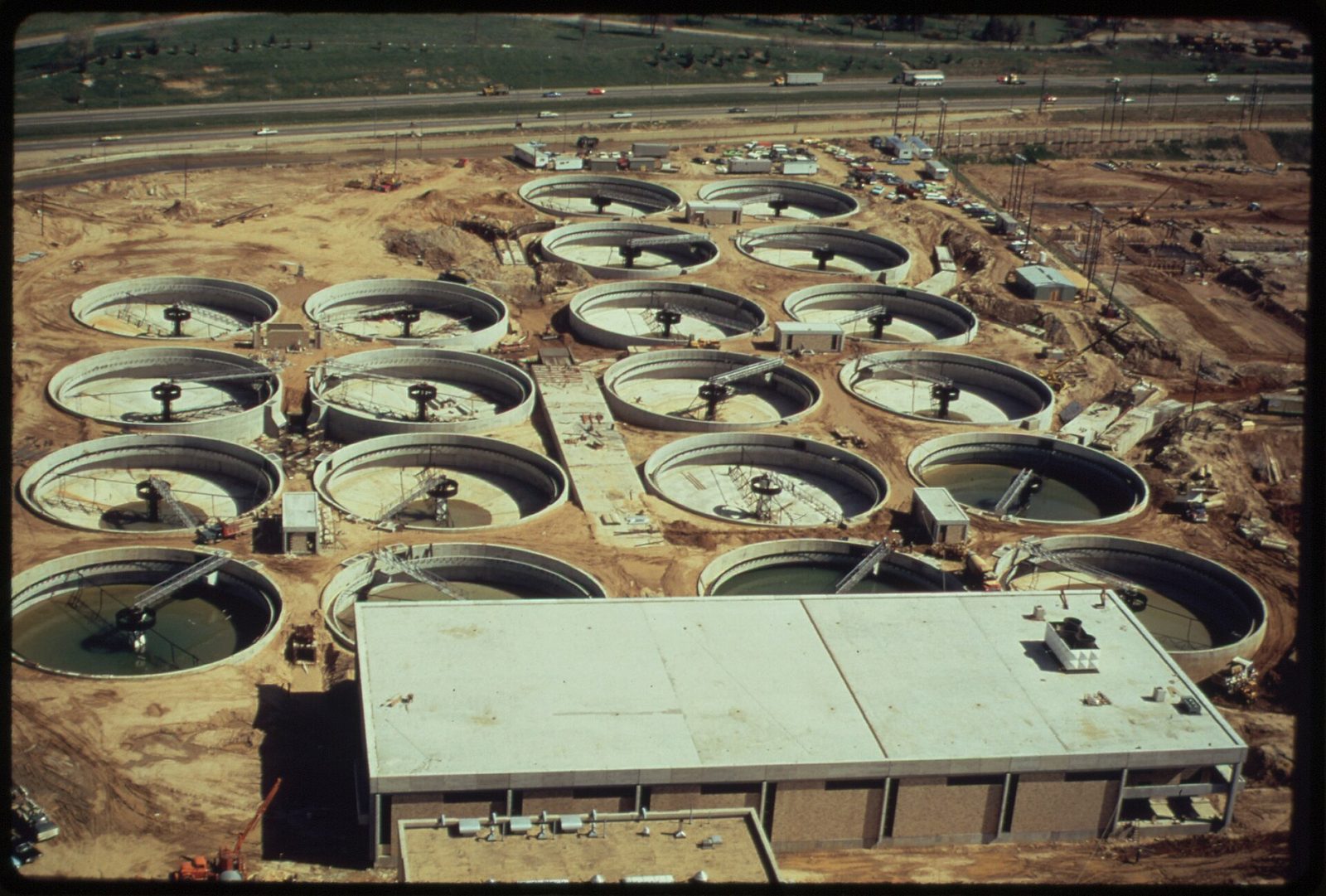
There is a DN1200 glass-reinforced plastic outfall at a plant we worked on that has never been cut. Not once in nineteen years. The utility wanted flow data on it for a permit renewal, and the only realistic option was a clamp-on ultrasonic flow meter strapped to the outside of a pipe that nobody was going to drain.
Two hundred metres upstream, on the raw influent line, a flanged electromagnetic meter has been in service since the plant was built. Different problem, different instrument. Both correct.
That is the useful way to think about wastewater metering. Not “which meter is best”, but “which meter belongs at this point”.
What makes wastewater hard
Three things, and they compound each other.
Solids. Raw sewage carries grit, rags, and things that should not be in a sewer. Sludge runs 0.5% to 5% dry solids. Anything with a moving part or a bluff body in the stream will foul or erode, usually inside a year.
Coating. Grease and struvite deposit on electrodes and on the pipe wall. A coated electrode stops conducting. A coated ultrasonic transducer stops hearing.
Low and variable flow. Design flow might be 6,600 gpm. At three in the morning on a dry week, the same plant runs at 900 gpm. Meters sized on peak spend most of their life in the bottom fifteen percent of their range.
Where the electromagnetic flow meter belongs
An electromagnetic flow meter has an empty bore. Nothing catches rags, nothing wears, and there is no pressure loss beyond pipe friction. For raw influent, primary effluent and digested sludge, this is the default and it is hard to beat.
The selection details that actually matter are liner and electrode, not the accuracy class:
| Duty | Liner | Electrode | Reason |
|---|---|---|---|
| Raw influent, grit present | Hard rubber or polyurethane | 316L or Hastelloy C | Abrasion resistance beats chemical resistance here |
| Primary / secondary effluent | Hard rubber | 316L | Standard build is sufficient |
| Digested sludge | Hard rubber | Hastelloy C | Sulphide attack kills cheaper alloys |
| Chemical dosing (ferric, polymer) | PTFE | Hastelloy C or tantalum | Small line, high concentration |
| Final effluent, discharge metering | PTFE or hard rubber | 316L | Regulatory data — take the higher accuracy class |
Two build choices come up in nearly every project. First, full-bore versus insertion. Insertion meters cost less on large pipe and install through a tapping without cutting the line, but they sample one path and lose accuracy on short runs. Above DN600 with a long straight run, insertion is defensible. Below that, go full bore.
Second, grounding. Wastewater lines are often lined or non-conductive, and a badly grounded electromagnetic meter will drift several percent with no error code. Grounding rings on plastic or lined pipe, and a copper braid bonding meter flange to pipe flange.
Where clamp-on ultrasonic wins
The clamp-on ultrasonic flow meter measures from outside the pipe. Nothing enters the flow. Nothing coats on the wetted side. Installation takes twenty minutes with the line live.
That makes it the obvious answer for:
- Existing pipe that cannot be shut down — the DN1200 outfall above
- Retrofit and temporary flow surveys, where the meter moves between points
- Verification of a fixed meter during an audit, as a portable reference
- Clean water duties — filtrate, backwash, cooling water — where the pipe is full and the fluid homogeneous
The limits are equally clear. The pipe must be full. Entrained air from a downstream drop shaft scatters the signal. Heavy wall, cement lining, or a rough cast-iron exterior attenuates the beam. And on a pipe carrying 3% sludge the sound path through suspended solids is unreliable — you will get a reading, but not necessarily a true one.
One phrase worth knowing if you are comparing quotations: what suppliers call permanent ultrasonic flow meters are simply clamp-on units installed for continuous service rather than as portables. The transducer mounting and the pipe-surface preparation are what separate a permanent installation from a temporary one, not the electronics.
The part-full pipe problem
Gravity sewers and plant outfalls frequently run part-full. A clamp-on meter on a part-full pipe measures the velocity of a shallow stream and multiplies by the full cross-section, which overstates flow. If the pipe is not full at the metering point, either relocate to a full section or switch to an open-channel method with a flume and level sensor. No amount of signal processing fixes a geometry problem.
Size for the night-time minimum
This is the most common design error we see. A meter sized on peak flow has an accuracy band that starts at five or ten percent of maximum. On a plant with a 7:1 diurnal swing that is fine. On a combined sewer with storm inflow, peak-to-dry-weather flow can hit 20:1, and the meter spends the dry season below its stated range.
Options, in order of preference:
- Split the range across two meters in parallel, with automatic isolation of the larger one
- Choose a meter with a wider stated range and accept ±2% at the low end
- Use a clamp-on unit with a dedicated low-flow mode for the dry-weather period
Installation rules that get broken
Straight run. Electromagnetic: 5D upstream, 3D downstream as a floor; 10D/5D if there is a double bend or a pump nearby. Clamp-on wants more, not less — 10D upstream, transducers on the same generatrix.
Position on the pipe. Avoid the top of a horizontal line, where air collects, and the bottom, where grit settles over the electrodes. Ten o’clock or two o’clock is the usual compromise.
Earthing on plastic pipe. Grounding rings, every time. We have watched a plant chase a 6% offset for eight months before finding the missing ring.
Zero check after commissioning. Close the downstream valve, fill the pipe, confirm zero flow reads zero. If it does not, fix it before the meter goes into service — after that nobody gets another chance.
A layout that works
Raw influent DN600: electromagnetic, hard rubber liner, Hastelloy electrodes, full bore, IP68 sensor for the wet well.
Return activated sludge DN300: electromagnetic, hard rubber. Sludge lines are where cheap electrodes fail first.
Chemical dosing DN25: electromagnetic with PTFE liner, or Coriolis if the dose rate is very low.
Final effluent DN800 concrete-lined: clamp-on ultrasonic with insertion transducers, or full-bore electromagnetic if a shutdown can be arranged at the next maintenance window.
Portable reference: one clamp-on meter in the workshop, calibrated annually, used for verification and for the flow surveys the regulator occasionally requests.
Frequently asked questions
Can an electromagnetic meter handle sludge at 5% solids?
Yes, with an abrasion-resistant liner and corrosion-resistant electrodes. Below about 10% solids the signal is stable. Above that the flow stops being homogeneous and accuracy degrades regardless of technology.
Why does our clamp-on disagree with the inline meter by 8%?
Nine times out of ten it is wall thickness entered wrongly, or transducers mounted across a weld seam. Check those two before suspecting either instrument.
Is Doppler better for dirty water?
Doppler works on suspended solids and needs a minimum concentration to function. Useful for heavily solids-laden streams, less accurate than transit-time, and not appropriate for regulatory discharge data.
The electrode and liner question comes up in almost every chemical plant too, and the chemistry logic there is stricter than in wastewater: liner and electrode selection for corrosive service covers it. If the plant also runs a sludge digester with gas recovery, the gas side is metered differently — see natural gas flow meter selection for metering stations.