


A gas roots flow meter measures volume the way a bucket measures water. Two figure-eight rotors turn inside a measuring chamber, and each revolution traps a fixed volume and passes it downstream. The count is the volume. There is no velocity to infer and no Reynolds number to satisfy, which is why gas roots flow meter works on a 30 mbar city main where nothing else does.
That mechanical certainty is the reason the design has survived a century. A gas roots flow meter does not care whether the gas is light or heavy, hot or cold, fast or slow, as long as it is clean and the rotors are not worn. It reads the same at 5 percent of range as at 100 percent, and no electronic meter in this price bracket can say that.
On this page
How the gas roots flow meter works
Two rotors, each shaped like a figure eight, rotate in opposite directions inside a machined chamber. The rotor profiles are generated so that the two stay in contact without touching, and the gap between them and the chamber wall is a few hundredths of a millimetre.
Each quarter revolution traps a known volume between a rotor face and the chamber wall and carries it to the outlet. Four displacements per revolution per rotor, so the geometry gives a fixed swept volume that can be calculated to a fraction of a percent.
The output is mechanical. A gear train drives a counter, and a pulse output or a reed switch can be added for remote reading. Because the measurement is geometric rather than dynamic, the calibration is stable over years and gas roots flow meter keeps reading correctly as it wears, only losing a little through the increasing gap.
Why there is no Reynolds number problem
A turbine meter infers flow from rotor speed, and rotor speed depends on velocity. A gas roots flow meter traps and counts discrete volumes, so the relationship between rotation and volume is set by the chamber geometry alone.
That is why the turndown is so wide. A turbine meter at 3 percent of maximum is below its working range. A gas roots flow meter at 3 percent of maximum is still trapping and counting the same volumes, with only a small increase in slip through the gaps.
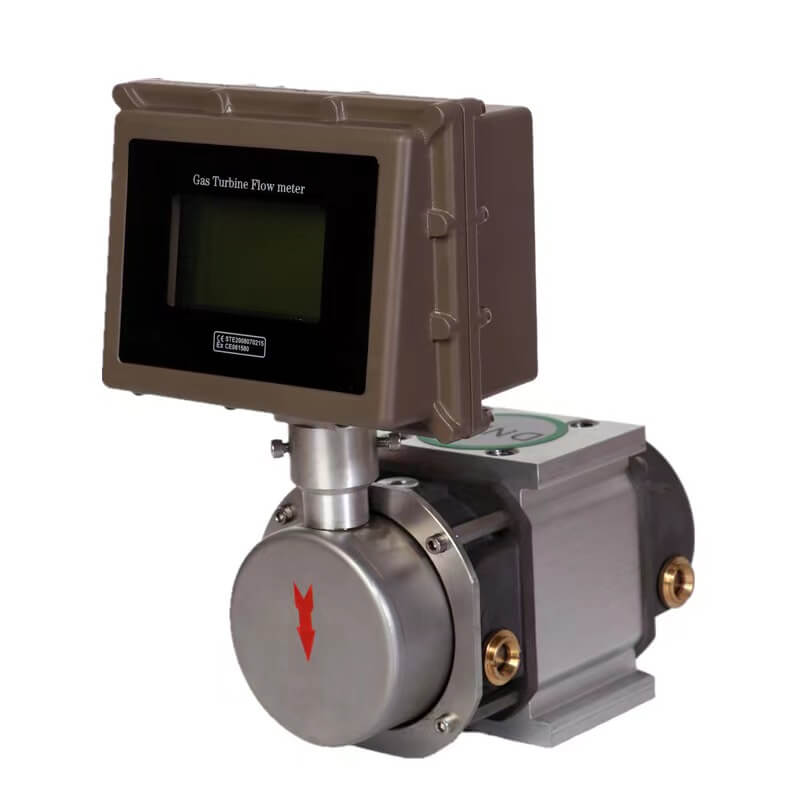
Specifications
| Parameter | Range |
|---|---|
| Nominal diameter | DN25 to DN200 |
| Medium | Natural gas, LPG vapour, town gas, inert gas |
| Accuracy | plus or minus 1.0 percent of reading |
| Repeatability | 0.1 percent of reading |
| Turndown | 1:20 standard, up to 1:160 on selected sizes |
| Nominal pressure | 1.6 MPa standard, higher on request |
| Medium temperature | -20 C to +60 C |
| Pressure loss | 0.1 to 0.5 mbar at normal flow, size dependent |
| Body material | Cast iron with epoxy coating, or aluminium alloy |
| Rotor material | Impregnated aluminium or engineering plastic |
| Straight run | None required, a filter is recommended |
| Output | Mechanical counter, low frequency pulse, RS485 optional |
| Protection | IP65, IP67 optional |
| Installation | Horizontal, or vertical with upward flow |
The pressure loss figure is the one that makes gas roots flow meter possible on low pressure networks. Half a millibar at normal flow is negligible when the main is running at 30 mbar. A turbine meter on the same main would take 0.3 bar, which is the whole network pressure.
Turndown and why it matters
City gas demand swings enormously. A commercial customer with a boiler might run at 20 percent of design capacity overnight and 100 percent at breakfast. gas roots flow meter with a 1:10 turndown loses the night hours entirely, and those hours are a third of the gas.
A gas roots flow meter with 1:160 turndown keeps counting through the whole swing. The accuracy at the bottom is slightly worse because slip becomes a larger fraction of the trapped volume, but gas roots flow meter still reads, and a reading with two percent uncertainty is worth far more than a zero.
This is also why gas roots flow meter is used for billing. A utility that cannot measure night flow cannot bill for it, and the difference between measuring and not measuring a third of the consumption is the difference between a viable network and a subsidised one.
Low pressure and pressure loss
Low pressure distribution is the natural home of the gas roots flow meter. At 30 mbar there is no pressure budget for a significant loss, and every other technology either needs more pressure than the network has or loses too much of what it has.
gas roots flow meter itself is a positive displacement device, so the differential across it is small by construction. The filter upstream will cost more pressure than gas roots flow meter, which is worth remembering when you are sizing the regulator.
Above 1.6 MPa the design becomes impractical because the chamber walls have to be thick enough to distort the measuring geometry under pressure. If the line runs at 10 bar, a turbine or a precession vortex meter is the right family.

Clean gas is not optional
The rotor gap is a few hundredths of a millimetre. A particle larger than that will jam the rotor or score the chamber wall, and either failure is expensive. A gas roots flow meter needs a filter, and the filter needs maintaining.
Rust and pipe scale are the usual culprits, especially on older cast iron mains. A strainer upstream catches the bulk of it. Where the gas carries fine dust, a cyclone or a cartridge filter is worth the cost, because a seized rotor means gas roots flow meter exchange rather than a repair.
Liquid carryover is the other problem. Condensate in the chamber increases the slip and gas roots flow meter over-reads, and in winter it can freeze the rotors solid. Fit a knock-out drum on any line where condensation is possible.

Compared with turbine and diaphragm
| Gas roots | Gas turbine | Diaphragm | |
|---|---|---|---|
| Accuracy | 1.0 percent | 1.0 percent | 1.5 to 2.0 percent |
| Turndown | 1:20 to 1:160 | 1:20 | 1:50 to 1:100 |
| Pressure loss | Very low | Moderate | Very low |
| Low pressure gas | Excellent | Poor | Excellent |
| Dirt tolerance | Moderate | Poor | Moderate |
| Maximum size | DN200 | DN300 | DN150 |
| Cost at DN100 | High | Moderate | Low |
Against the gas turbine flow meter, the roots meter wins on low pressure and turndown and loses on maximum size and on capital cost at large sizes. Against a diaphragm meter, it wins on turndown and accuracy and loses on price at small sizes, which is why domestic metering still uses diaphragms.
Against a precession vortex flow meter, the roots meter wins on pressure loss and low pressure operation and loses on size range and on tolerance of dirty gas.
Where it is used
City gas distribution at district and building level. Commercial and industrial customers on a low pressure main. Sub-metering inside a factory where the incoming supply is at 30 to 100 mbar.
LPG vapour metering, where the gas is clean and the flow is steady. Town gas and mixed gas networks where the composition varies and a velocity based meter would need constant recalibration.
Check metering, where a second meter is installed to verify a billing meter. The gas roots flow meter’s stability makes it a good reference, and its wide turndown means it can follow the billing meter through the whole range.
Installation
- Fit a strainer upstream. This is the requirement that decides how long the meter lasts.
- Install horizontally with the counter readable, or vertically with upward flow.
- No straight run is required, but leave room to remove the meter for service.
- Fit a bypass if the supply cannot be interrupted.
- Keep the meter out of direct sun and away from heat sources. The chamber geometry changes with temperature.
- Ground the body on any installation with a pulse output, to protect the reed switch.
- Do not over-tighten the flange bolts. Distortion of the chamber is a real failure mode.
Maintenance and calibration
Recalibrate every three to five years. The meter wears slowly and predictably, and the drift is usually an increase in slip, which reads low at low flow and normal at high flow.
Between calibrations, watch the pressure loss. A rising differential means the filter is loading or the rotors are fouling. Both are visible long before the reading changes.
Do not lubricate the chamber. The rotors run dry on a gas film, and oil attracts dust and turns into a grinding paste. If gas roots flow meter arrives from a site with oil in it, the site has been adding something it should not.
Ordering checklist
- Gas type and calorific value, and whether the composition varies
- Maximum, normal and minimum flow
- Line pressure, including the minimum the network sees in winter
- Line size and connection standard
- Base conditions for the corrected volume, if compensation is needed
- Counter type and whether a pulse output or RS485 is required
- Filtration already installed, and its rating
- Indoor or outdoor installation
A worked sizing example
A commercial building on a 50 mbar city main. The boiler takes 60 m3/h at maximum, the kitchen and hot water take 8 m3/h, and at night the standing load is 1.5 m3/h. Which size?
A DN50 gas roots flow meter covers roughly 1 to 100 m3/h at a 1:100 turndown. The maximum of 60 m3/h sits at 60 percent of range, which is comfortable. The night load of 1.5 m3/h sits at 1.5 percent of range, where slip begins to matter but the meter still counts.
Check the pressure loss at maximum. Through a DN50 roots meter at 60 m3/h on a 50 mbar main, expect 1 to 2 mbar. That leaves the network pressure essentially untouched, which is the whole reason for choosing gas roots flow meter.
Now the alternative. A turbine meter at DN50 would have a 1:20 turndown, so the floor would be 5 m3/h and the night load would read zero. A precession vortex meter would lose 0.3 bar, which is six times the available network pressure. Neither works, and this is the calculation that decides the technology before the price list is opened.
Pulse output and remote reading
The mechanical counter is the legal record on most installations, and the pulse output is how that record reaches a billing system. The pulse is usually generated by a reed switch or a Hall sensor driven by a magnet on the rotor shaft.
Reed switches are cheap and they wear out. A reed switch cycling at 100 Hz will fail in a few years, so specify a Hall sensor where the flow is high and continuous. Where the flow is low and intermittent, a reed switch will outlast the meter.
The pulse weight matters for resolution. gas roots flow meter that outputs one pulse per 0.1 m3 cannot resolve a 0.05 m3 test draw. Check the pulse weight against the smallest quantity you need to measure, not against the total.
Where no cable is possible, the counter is read optically or by a camera. Both work, both introduce transcription risk, and both are worth automating if the customer count is large.
Field failures and what causes them
A seized rotor is almost always dirt. Pull the meter, look at the chamber wall for scoring, and check the upstream strainer. If the strainer is clean, the dirt came from commissioning, and the line should have been blown through before the meter went in.
gas roots flow meter reading high at low flow is usually worn rotors. The gap has opened, slip has increased, and the error shows up first where the trapped volume is smallest relative to the slip. A recalibration confirms it and a rotor set fixes it.
A meter reading low across the range is usually a partially blocked filter. The differential rises, the pressure at the meter falls, and the gas expands less than the meter assumes. Check the filter differential before you touch the meter.
Condensate in the chamber is the winter failure. The meter over-reads, then the rotors freeze and the meter stops. A knock-out drum and a trace on the outlet line solve it.
Living with a fleet of them
A utility that owns a thousand gas roots flow meters is not really buying meters. It is running a maintenance programme, and the meter design either helps that programme or fights it.
The gas roots flow meter helps because it fails slowly and visibly. The rotors wear, slip increases, and the reading drifts low over years. There is no sudden failure and no mystery. A periodic comparison against a check meter catches the drift long before it matters, and a rotor set restores the original performance.
It also helps because the counter is mechanical. A meter with a mechanical total does not lose its history when a battery dies, and that matters on a billing asset with a fifteen year life. The pulse output is convenient, but the mechanical register is the record.
The gas roots flow meter does not help on gas quality. Every one of them needs a filter, every filter needs a cartridge, and the cartridge needs a change schedule. A fleet without a filter programme is a fleet with seized rotors, and a seized rotor is a meter exchange rather than a service.
Choosing between the two sizes you were quoted
Enquiries usually come back with two sizes and a question about which one to take. The answer is almost always decided by the night load rather than the peak.
Take the smaller size if the night load is more than 5 percent of its maximum. Take the larger size if the peak would otherwise exceed 80 percent of range, because a gas roots flow meter run flat out wears faster and loses more pressure.
If neither size covers both ends, the honest answer is that one meter cannot do the job. Either accept that the night load reads zero, or split the load across two runs with a small meter for baseload and a large one for peak. Utilities do this more often than the catalogue suggests, and it is cheaper than replacing a meter every three years because it spent its life at the top of its range.
Ask for the slip curve with the quotation. A gas roots flow meter is specified on its accuracy band, and the slip curve tells you what happens outside it. Suppliers who can produce that curve on request are usually the ones who will still be answering the phone in five years.
Common questions
Can it be used on natural gas at 4 bar?
Yes, up to 1.6 MPa. Above that the chamber design becomes impractical and a turbine or vortex meter is the better choice.
Why does it need a filter when a turbine meter does not?
A turbine meter needs one too, and to a finer standard. The difference is that the roots rotor gap is smaller and a jam is a hard failure rather than a slow drift.
How accurate is it at very low flow?
Within one percent down to about 10 percent of maximum, then gradually wider as slip becomes significant. At 2 percent of maximum expect two to three percent uncertainty, which is still far better than not measuring.
Does it need straight run?
No. That is one of its advantages. A strainer is required, straight pipe is not.
Can it measure in both directions?
The standard design is unidirectional. Reverse flow can damage the rotors, so fit a non-return valve if backflow is possible.
Related reading
For higher pressure gas where the roots meter cannot go, see the gas turbine flow meter and the precession vortex flow meter. For liquid service on the same displacement principle, the liquid turbine flow meter is the velocity based alternative.
Reference for gas meter calibration and installation: OIML recommendations set out the accuracy classes and test procedures used across most gas distribution networks.