


A precession vortex flow meter is the gas meter that fits where a turbine will not. It needs three diameters of straight run instead of ten, it has no rotor to wear, and the compensation electronics sit inside the head. On a city gate station or a factory gas inlet where the pipework is already built, that combination solves a problem nothing else solves at the price.
The principle is different from a standard vortex meter. Fixed guide blades spin the gas into a vortex, the vortex core precesses around the diffuser like a coin spinning in a bowl, and a piezoelectric sensor picks up the precession frequency. The frequency tracks volumetric flow, and because the swirl is forced rather than shed, precession vortex flow meter is far less sensitive to an upstream disturbance.
On this page
How the precession vortex flow meter works
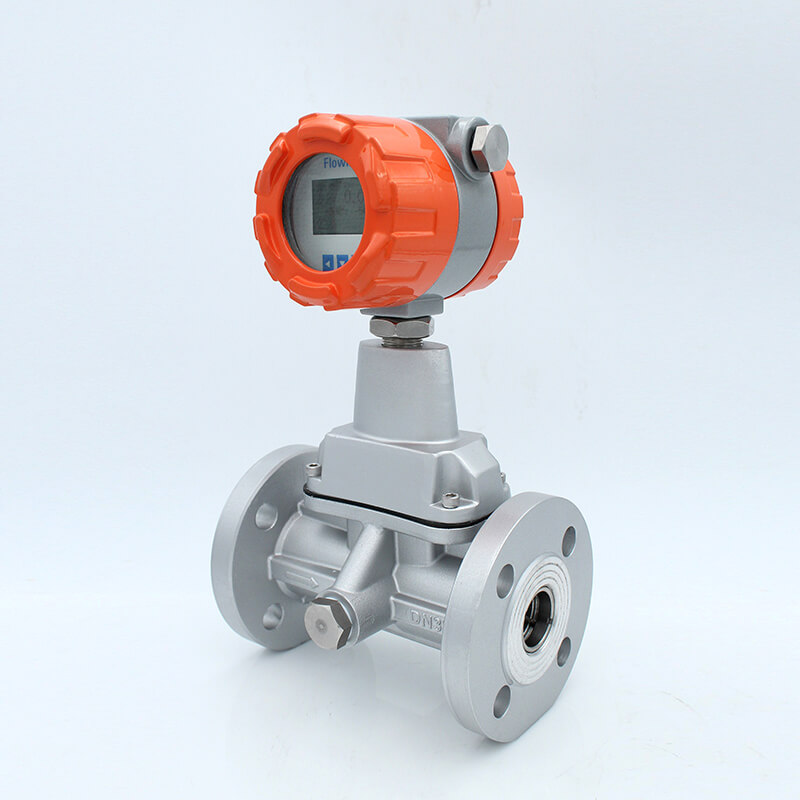
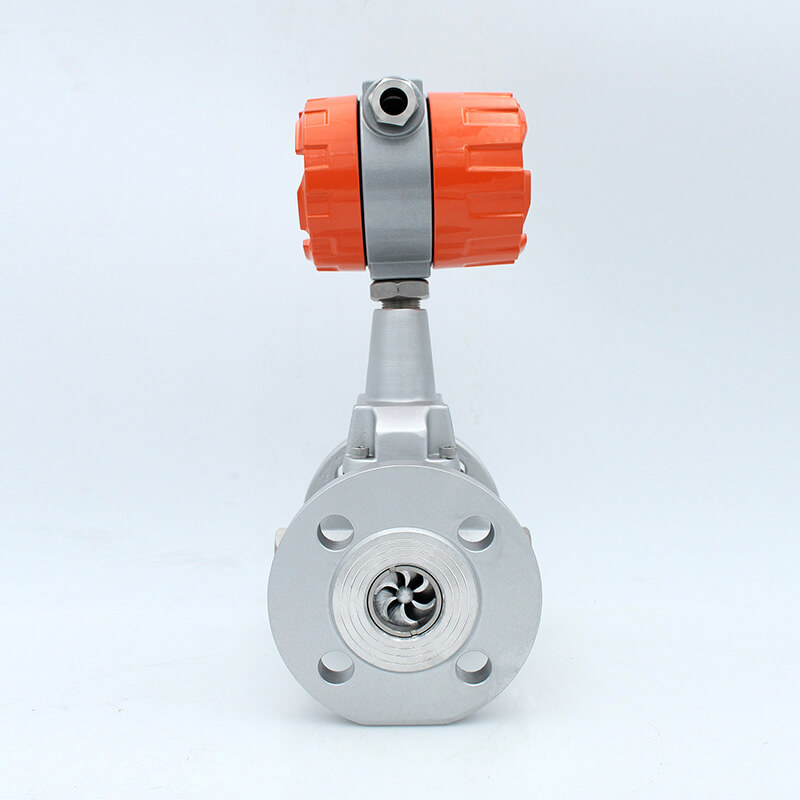
Gas enters through a set of fixed helical guide blades that impart a strong rotation. The swirling flow passes into a diffuser section where the vortex core begins to precess, tracing a cone around the axis. The frequency of that precession is proportional to the volumetric flow rate.
A piezoelectric sensor mounted in the wall of the diffuser detects the pressure pulse each time the core passes. Because the swirl is generated mechanically rather than shed from a bluff body, the signal is strong and the relationship between frequency and flow holds over a wide band.
Why forced swirl matters
A standard vortex meter depends on the flow arriving with a clean, symmetric profile, which is why it wants fifteen diameters upstream. A precession vortex flow meter creates its own swirl, so an asymmetric inlet profile gets absorbed by the guide blades rather than corrupting the measurement.
That is the engineering reason for the three diameter claim, and it is why precession vortex flow meter is popular on packaged skids and retrofit jobs where the pipe run is fixed. It is not a marketing number. It is a consequence of putting the swirl generator upstream of the measurement zone.
Specifications
| Parameter | Range |
|---|---|
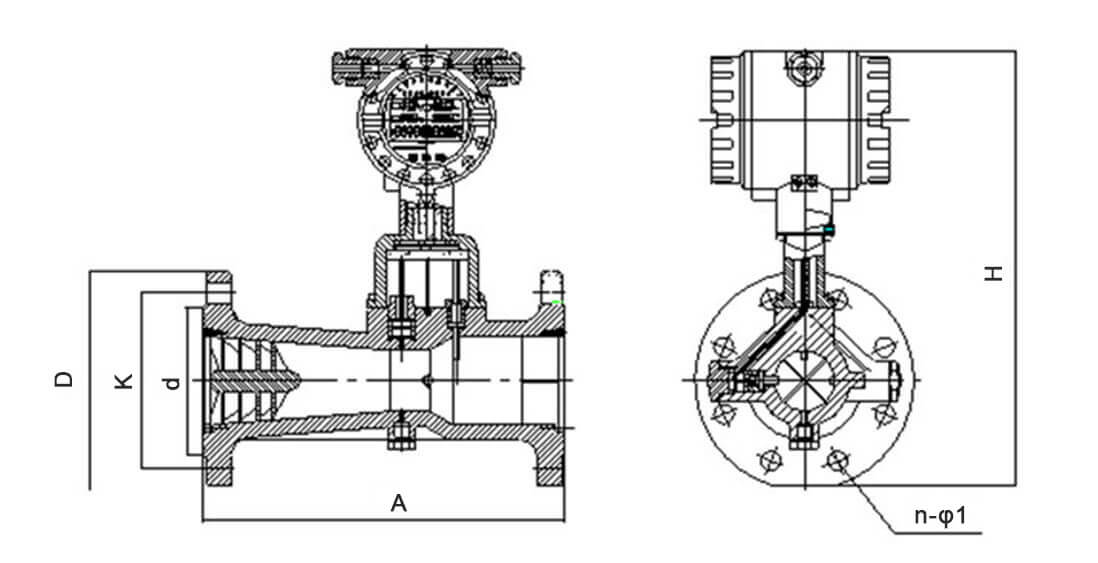
| Nominal diameter | DN25 to DN300 |
| Medium | Natural gas, LPG vapour, coal gas, compressed air, nitrogen |
| Accuracy | plus or minus 1.5 percent of reading, plus or minus 2.5 percent at the low end |
| Repeatability | 0.2 percent of reading |
| Turndown | 1:10 standard, 1:15 on selected sizes |
| Nominal pressure | 1.6 MPa standard, 2.5 / 4.0 / 6.3 MPa optional |
| Medium temperature | -20 C to +80 C |
| Ambient temperature | -30 C to +55 C |
| Body material | Stainless steel or aluminium alloy with epoxy coating |
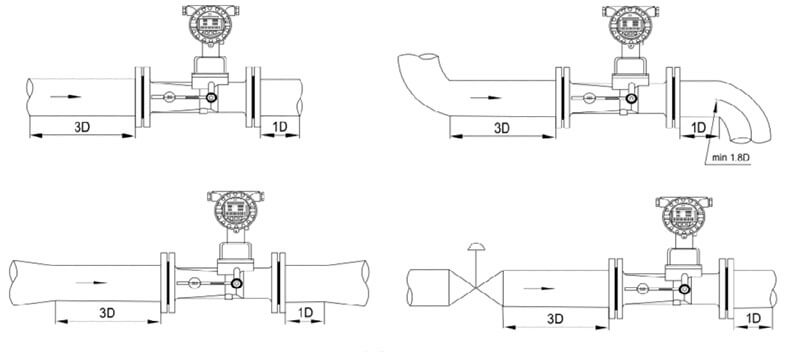
| Straight run | 3 DN upstream, 1 DN downstream |
| Pressure loss | 0.3 to 0.8 bar at full scale, size dependent |
| Output | Pulse, 4-20 mA, RS485 Modbus |
| Power supply | 24 VDC, 3.6 V lithium battery, or solar |
| Protection | IP65 standard, IP67 optional, Ex ia IIC T4 |
| Data storage | Historical totals, alarm log, up to 12 months of daily records |
The accuracy of 1.5 percent is wider than a turbine meter’s 1.0 percent, and that is the honest trade. You give up half a percent of accuracy and get precession vortex flow meter that survives dirty gas, needs no filtration to the same standard, and fits in a third of the pipe run.
Built-in compensation
The head contains a pressure sensor and a temperature sensor, and the firmware converts working-condition volume to standard volume using the gas compressibility factor. Base conditions are configurable, and the total is stored in non-volatile memory.
This matters on a distribution network because the alternative is three separate instruments and a flow computer. A precession vortex flow meter with the compensation built in replaces all of it, and there is one number to defend at month end rather than three that have to reconcile.
Configure it properly at commissioning. The base pressure, base temperature and gas composition are set once and then forgotten, which is exactly why they cause problems later. Write them on the commissioning sheet, photograph the display, and keep it with precession vortex flow meter.
Battery operation
The lithium battery version runs three to five years on a duty cycle of one measurement every few seconds. It is the standard choice for district metering points with no power, and it stores daily totals so a missed download does not lose data.
Battery life falls fast if precession vortex flow meter is asked to drive a 4-20 mA loop continuously. If you need an analogue output and no mains power, use solar rather than battery.
Three diameters of straight run
Three diameters upstream and one downstream is the published requirement, and it holds for a single elbow. For two elbows in different planes, add two diameters. For a partly closed valve immediately upstream, add four or move precession vortex flow meter.
Compare that with a standard vortex flow meter at fifteen diameters and an orifice plate at ten to twenty, and the reason precession vortex flow meter exists becomes obvious. On a skid that was designed around a different meter, three diameters is often the difference between a retrofit and a rebuild.
The downstream requirement is short because nothing downstream can affect the precession once it is established. That is not true of a standard vortex meter, where a downstream disturbance can reflect back into the shedding zone.
Where it stops working
Low pressure is the first limit. The pressure loss of 0.3 to 0.8 bar at full scale is fine on a 4 bar distribution main and impossible on a 30 mbar network. Below about 0.5 bar line pressure, a Roots meter or a rotary displacement meter is the correct choice.
Very low flow is the second. Like any vortex device, it needs a minimum Reynolds number before the precession is stable. Below that precession vortex flow meter reads zero, and on a line with a strong day-night swing the night hours disappear.
Vibration is the third, though less than on a standard vortex meter because the signal is stronger. Long unsupported spans and compressor discharge lines still need care.
And wet gas is the fourth. Liquid droplets disturb the vortex core and the reading goes noisy before it goes wrong. If the gas is saturated, fit a knock-out drum upstream.
Sizing
Size on velocity at operating conditions. The usable band is roughly 5 to 50 m/s, and the normal flow should sit between 30 and 70 percent of maximum.
Convert carefully. precession vortex flow meter selected on 500 Nm3/h of natural gas looks adequate until you convert to actual flow at 4 bar, where it becomes about 125 m3/h, and through a DN50 bore that is 17 m/s, which is fine. Through a DN25 bore it is 70 m/s, which is not.
The pressure loss check comes second. At the maximum flow, confirm the loss against the available pressure. On a regulating station where the outlet is held at 4 bar, half a bar of meter loss is a design decision, not a detail.
Compared with turbine and Roots
| Precession vortex | Gas turbine | Roots | |
|---|---|---|---|
| Accuracy | 1.5 percent | 1.0 percent | 1.0 percent |
| Moving parts | None | Rotor and bearing | Two rotors |
| Straight run | 3 DN | 2 DN | Minimal |
| Dirt tolerance | Good | Poor | Moderate |
| Pressure loss | 0.3 to 0.8 bar | 0.3 to 0.5 bar | Low |
| Low pressure gas | Poor | Moderate | Excellent |
| Turndown | 1:10 | 1:20 | 1:20 to 1:160 |
| Compensation | Built in | Optional | Optional |
Against the gas turbine flow meter, precession vortex flow meter gives up accuracy and turndown and gains dirt tolerance and a shorter pipe run. For custody transfer where the number is invoiced, the turbine is still the better answer. For internal metering and sub-stations, the precession vortex flow meter is usually enough.
Against the gas Roots flow meter, the trade is pressure. Roots meters work at low pressure where precession vortex flow meter cannot, and they cost more at larger sizes. If the line runs below 1 bar, Roots. Above 2 bar, precession vortex flow meter is competitive.
Installation
- Three diameters upstream, one downstream, counted from the flange face.
- Install horizontally with the head up, or vertically with upward flow. Downward flow traps liquid at the sensor.
- Fit a filter if the gas can carry rust or pipe scale. A precession vortex flow meter tolerates dirt better than a turbine, but not indefinitely.
- Ground the body independently of any high voltage system.
- Leave access to the head. The battery and the display are the two things that need attention.
- On outdoor installations, fit a sunshade. The display fades in direct sun and the battery life shortens.
What goes wrong in the field
Wrong base conditions is the most common complaint, and it is not precession vortex flow meter fault. Two meters on the same network with different base temperatures will disagree by a percent or two forever.
Blocked guide blades is the second. Rust and pipe scale collect on the helical blades and change the swirl angle, which shifts the K-factor. The symptom is a reading that drifts low over months.
A dead battery on a remote unit is the third, and it always happens in winter. Check the battery date at every site visit and replace on schedule rather than on failure.
And a flooded sensor from a horizontal installation with the head down is the fourth. Water collects in the head and the electronics fail. The head goes up, always.
Ordering checklist
- Gas type and composition, and whether the composition varies
- Maximum, normal and minimum flow, at line or base conditions
- Line pressure, and the minimum pressure the network ever sees
- Line size, flange standard and pressure class
- Base conditions for the standard volume total
- Power: mains, battery or solar
- Output and protocol, and whether the data logger needs to read history
- Hazardous area classification
Precession vortex versus a standard vortex meter
Both use vortex behaviour and both have no moving parts, so buyers often treat them as interchangeable. They are not, and the differences decide which one fits a given skid.
A standard vortex flow meter sheds vortices from a bluff body placed in the flow. The shedding depends on the incoming profile, which is why it wants fifteen diameters of straight pipe. A precession vortex flow meter forces the swirl with guide blades, so the incoming profile matters much less and three diameters is enough.
The trade is pressure loss. Forcing a swirl costs energy, and the precession design typically loses 0.3 to 0.8 bar where a standard vortex meter loses 0.1 to 0.3 bar. On a high pressure gas main that difference is easy to absorb. On a low pressure main it is impossible.
The other difference is the medium. A standard vortex meter handles steam and liquid as well as gas, and it handles them well. A precession vortex flow meter is a gas instrument, and putting it on steam is a mistake that shows up as a drifting reading and eventually a failed sensor.
| Precession vortex | Standard vortex | |
|---|---|---|
| Straight run | 3 DN | 15 DN |
| Pressure loss | 0.3 to 0.8 bar | 0.1 to 0.3 bar |
| Media | Gas only | Gas, steam, liquid |
| Compensation | Built in | Optional module |
| Turndown | 1:10 | 1:10 to 1:15 |
| Accuracy | 1.5 percent | 1.0 to 1.5 percent |
If the pipe run is generous and the medium might be steam, choose the standard vortex. If the pipe run is fixed and the medium is definitely gas, the precession vortex flow meter saves a fabrication job.
Data logging and remote reading
Most precession vortex flow meters sold today are sold as much for their logging as for their measurement. The head stores daily totals, hourly flow, alarm events and battery status, typically for twelve months at hourly resolution.
That history is what makes a distribution network manageable. A utility that reads precession vortex flow meter once a month sees a total and nothing else. A utility that downloads a year of hourly data sees the night baseline, the winter peak, the day the regulator drifted, and the week the customer’s boiler ran continuously.
Read it over RS485 where a cable is possible, or by optical port or radio where it is not. Whatever the route, download on a schedule and keep the files. The value of the data is in the comparison, not in the single reading.
Alarms worth configuring
Set the low flow alarm below the smallest flow you expect to be real, not at zero. precession vortex flow meter that alarms every night on a legitimate zero is a meter whose alarms get ignored.
Set the pressure alarm at both ends. A falling inlet pressure tells you the regulator is passing, and a rising outlet tells you it has failed closed. Both are worth knowing before a customer calls.
Set the reverse flow alarm if backflow is physically possible. The meter will not measure it accurately, but knowing it happened is worth more than the number.
Inside a pressure regulating station
A typical city gate station has a filter, a regulator, a meter and an odoriser in series, and the meter is usually the item with the least space. That is why the precession vortex flow meter turns up there so often.
The measurement point should sit downstream of the regulator, where the pressure is stable and the flow profile has recovered. Three diameters after the regulator outlet is usually enough, and the meter’s own straight run requirement is met by the spool between the regulator and the outlet flange.
Put the temperature sensor where it sees the gas temperature rather than the ambient. On a station that runs intermittently, the pipe wall temperature lags the gas by hours, and a sensor clamped to the outside of the pipe will report the wall rather than the gas.
Why utilities standardise on the precession vortex flow meter
Standardisation is underrated. A utility with forty district metering points does not want forty different instruments, forty sets of spares and forty calibration procedures. It wants one model it knows, one battery it stocks, and one configuration sheet its technicians can follow without thinking.
That is the practical reason many gas companies settle on a precession vortex flow meter for district metering. The meter covers the size range from DN25 to DN300, the head is the same across sizes, and the configuration menu is identical whether the body is DN50 or DN200. A technician who has commissioned one has commissioned all of them.
The precession vortex flow meter also survives the environment. District metering points sit in pits, on walls and in cabinets where the temperature swings and the humidity is high. A meter with no moving parts and a sealed head handles that better than a turbine, which needs clean gas and a bearing that does not like condensation.
None of this makes the precession vortex flow meter the most accurate instrument available. It makes it the most practical one for a fleet, and fleet practicality beats a half percent of accuracy on a single point.
Common questions
Is it as accurate as a turbine meter?
No. Expect 1.5 percent against 1.0 percent. It compensates with dirt tolerance and a shorter pipe run, and for internal metering that is usually the better trade.
Can it be used for custody transfer?
In some jurisdictions, yes, if it is calibrated and sealed. Check the local metrology rule first, because many custody transfer codes still specify a turbine or a displacement meter.
What is the pressure loss?
0.3 to 0.8 bar at full scale depending on size. That is higher than a turbine and it is the main reason this meter is not used on low pressure networks.
Does it need a filter?
Not to the same standard as a turbine, but yes on any line that can carry rust. A coarse strainer upstream is cheap insurance against guide blade fouling.
How long does the battery last?
Three to five years at one measurement every few seconds. Driving a 4-20 mA loop continuously cuts that dramatically, so use solar if you need an analogue output.
Related reading
For custody transfer accuracy on the same gas, see the gas turbine flow meter. For low pressure distribution, the gas Roots flow meter is the alternative. If the line is steam rather than gas, a vortex flow meter is the right family.
Reference for gas metering practice: OIML international recommendations cover the metering requirements that most national gas codes are built on.